The Man Who Invented Television
Desi Arnaz gets his due in a new book
“The Man Who Invented Television”
October 15, 1951: seventy-five years ago.
Television was still a relatively new medium. Radio and motion pictures ruled the entertainment world. But on that night, the first episode of a brand-new TV series aired on CBS: “I Love Lucy.”
Todd S. Purdum’s 2025 book, Desi Arnaz: The Man Who Invented Television is a must-read for not only those who crave behind-the-scenes stories from the most successful situation comedy in television history, but also for anyone interested in how an industry bent to the wills of a very determined and creative husband-and-wife team.
Born in Santiago, Cuba, and the only son of aristocratic privilege, Desiderio Alberto Arnaz y de Acha III seemed to have an idyllic childhood. His father, a well-to-do pharmacist, became the mayor of Santiago – and Desi, as he was known, was raised as a prince. However, the 1933 Cuban Revolution sent the family off the island and into the slums of Miami. Desi arrived in the United States knowing no English, living in a rat-infested warehouse, penniless except for a job cleaning canary cages.
Desi’s only way out was music, then experiencing a Latin-influenced craze. After playing some clubs in the Miami area, Desi was spotted by the Latin superstar Xavier Cugat, the “king of the rhumba,” who was incidentally later married to Charo. Arnaz sang and played with Cugat’s band, and in one of the more memorable incidents described in the book, ran out of material so he just kept playing the congas until everyone in the establishment joined him in what became known as a “conga line.” Arnaz, from that point, gained celebrity as the popularizer of the conga. When Broadway lyricist Lorenz Hart saw Desi performing at a Miami Beach nightclub, he told his partner Richard Rodgers about him, which led to Desi auditioning for the Rodgers and Hart musical Too Many Girls.
Desi Arnaz was tapped to participate in the film adaptation of the musical, where he co-starred with B-movie queen Lucille Ball, and sparks flew instantly. Their attraction was intense and a passionate romance began immediately. Lucy was six years older than Desi, but no matter: the chemistry between them is palpable in the first scenes they shared in that now long-forgotten movie.
Lucille Ball didn’t start out as a comedienne. The blond-headed (she wasn’t a redhead yet) Jamestown, New York native had been a model and actress, known for never turning down a job as she appeared in over 60 motion pictures, also managing to serve time as a cigarette girl and even a pinup. Once Ball and Arnaz teamed up, their combined work ethic moved them through the entertainment pipeline to varying degrees of success: Arnaz as a touring musician, Ball as the star of the radio show “My Favorite Husband.”
“I Love Lucy” began with Lucy and Desi having aged out of the movie and music businesses, willing to take a chance on what Purdum called “the still-untested, second-tier medium of television.” In 1951, that was true. TV had not even been trying to compete with radio or the movies. But Arnaz was a visionary, and along with the head writer and showrunner for “My Favorite Husband,” Jess Oppenheimer, the team created a show that would change television forever.
On the night of the first filmed episode on September 8, 1951, Desi cooked a batch of arroz con pollo for the cast and crew while Lucy tended bar. Desi and Lucy’s mothers, like they would for 181 episodes, took their seats in a place of honor in the stands. Desi was sent out to warm up the crowd – the first Latino TV star and certainly the first band director to be featured on television.
It is mind-boggling to consider that, were it not for Desi Arnaz, the world might never have heard of Lucille Ball. The pioneering Arnaz hired in the best cinematographers, directors, lighting designers, writers, and producers to bring “I Love Lucy” to life. His visionary concept was, at the time, radical – a multiple-camera setup that used adjacent sets, performed in front of a live studio audience, recorded on 35mm film. It is important to point out that, at the time, all television shows were performed “live” as videotape had not yet been invented. The only way to see a TV show other than its original airing was to set up a film camera in front of the monitor as the show was being broadcast, leading to what were called “kinescopes.”
Desi’s innovations led to something unimaginable at the time: a business model that so far has brought us over seven decades of syndication and re-runs. Desi and Lucy founded their own production company, Desilu, housed at the old RKO Studios complex, that started small but eventually became one of the largest studios in Hollywood. Desilu would go on to produce hundreds of hours of memorable television, from “The Untouchables” to “Make Room for Daddy,” from “The Andy Griffith Show” to “Star Trek,” from “Mannix” to “Mission: Impossible.”
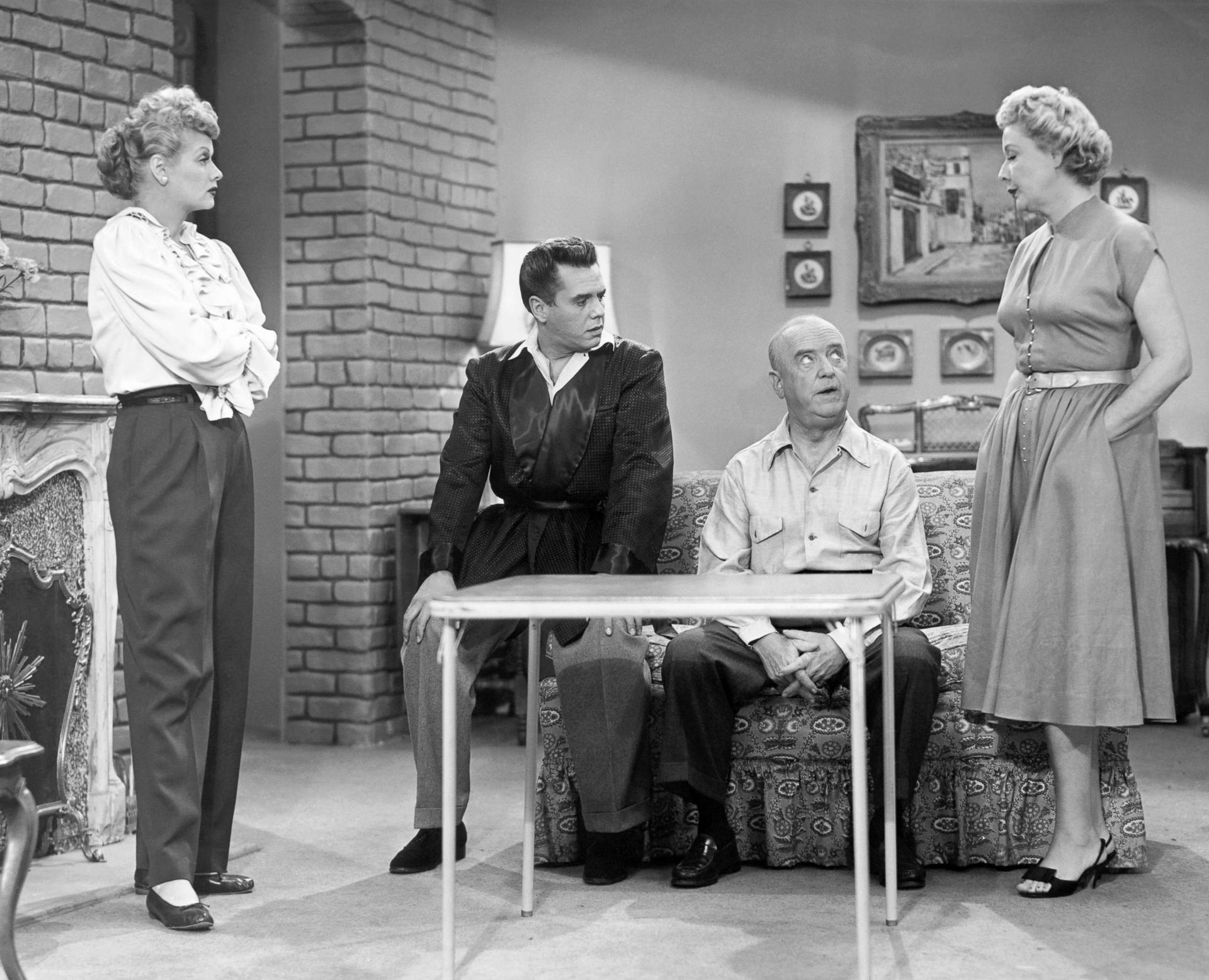
Lucy’s writers, Bob Carroll and Madelyn Pugh, would go on to have long careers in the industry. Pugh later recalled, “Lucy would do absolutely anything we dreamed up, and Desi would pay for it. If it was funny, we could do it.” The actors chosen to balance out Lucy and Desi as Lucy and Ricky Ricardo were Vivian Vance and William Frawley as Ethel and Fred Mertz. Vance was known mainly as a singer, having performed brassy Broadway roles in Anything Goes and Carousel; Frawley had been a well-known vaudevillian performer for decades but had a poor reputation in the business for being a disagreeable drunk. This team of writers and performers created magic together.
One of the finest examples, and certainly one of the greatest episodes of this or any series, occurs in 1953 with “Lucy is Enceinte.” In the episode, Lucy goes to Ricky’s nightclub, the Tropicana, and slips the maitre'd a note which says how a woman in the audience hasn’t yet told her husband that they're going to have a baby. The woman asks that Ricky sing “We’re Having a Baby, My Baby and Me” to the different women seated at the tables until he finds the expectant mother. He gets to Lucy, and she is just glowing! She nods ‘yes,’ and Ricky excitedly realizes he is going to be a father! It is one of the sweetest moments in television history.
On a personal note, my wife, Sena Thibodeaux, is a third cousin to Keith Thibodeaux, who played Little Ricky on “I Love Lucy.”
While climbing the ladder of success took years, even decades, it didn’t take long for alcoholism and sex addiction to take Desi Arnaz from the penthouse to the outhouse. While “I Love Lucy” was the number-one show on television, with 65% of American viewers tuning in every Monday night, the real-life marriage was falling apart.
This book is important because it finally gives credit to the underappreciated Arnaz for his incredible innovations and contributions to the television industry. In the face of tremendous racism in the industry and quite a bit of disrespect, Desi became the first Latino television star as well as the first Latino head of a Hollywood studio. Lucy and Ricky, it can also be claimed, had the first interracial marriage on television. The eternal bond between Lucy and Desi in real life survived divorce and remarriage to others; the impression Purdum gives is that the two of them were simply meant to be.
While their careers continued separately, Purdum concludes by saying, “the simple truth is that neither Lucy nor Desi ever achieved anything alone that approached the artistic achievement they enjoyed together. Their collaboration was lightning in a bottle, a once-in-a-lifetime combination that could never be recaptured but has been preserved forever, thanks to Desi’s insistence on putting ‘I Love Lucy’ on high-quality film.”
On October 15, 2026, catch an episode of “I Love Lucy” – 75 years after the show changed television, we are still laughing, all because Desi Arnaz made it happen.
Michael Bird is an assistant professor of music at Faulkner University in Montgomery, Alabama.