CBS: Good night, and good luck
In 24 hours, both CBS Radio and "The Late Show" on CBS come to an end
Good night, and good luck
When the story of broadcasting is told, this week will be remembered for a 24-hour period in which two legendary entities came to an end.
This Friday, May 22, CBS Radio will cease after 99 years of service; that same day, “The Late Show” franchise on CBS is also concluding.
Times are changing fast. Local newspapers are on the chopping block, while traditional radio and television struggle for space in a crowded media multiverse as they compete with the likes of YouTube and TikTok. However, a quick glance at some recent statistics shows that 10,073 students are graduating with journalism degrees this year. That hardly sounds like a prediction for “going out of business”.
What is happening at CBS seems more like belt-tightening, cost-cutting measures with some political overtones. David Ellison, the new owner of CBS, is very friendly with the Trump Administration and, when the President has criticized certain hosts or reporters, action has been taken over the past year.
But first, a fond farewell to CBS Radio.
The Columbia Broadcasting System began as the nation’s second radio network in 1927. However, its legacy of hard-hitting news reporting can be traced back to March 13, 1938, when Robert Trout reported on the Anschluss: Adolf Hitler’s Germany annexed Austria and took over the media. A then-unknown Edward R. Murrow, still in his 20s, was dispatched to report live news programs from five European cities. Murrow’s voice was heard from Vienna:
“This is Edward Murrow speaking from Vienna. It's now nearly 2:30 in the morning, and Herr Hitler has not yet arrived. No one seems to know just when he will get here. But most people expect him sometime after 10 o'clock tomorrow morning.”
And thus began the “CBS World News Roundup,” the longest-running news program on the air when it ends this Friday.
Other than Ed Murrow, CBS would become known for great reporting from Douglas Edwards (who began his career in Troy, Alabama), Eric Sevareid, Howard K. Smith, and Walter Cronkite. In fact, the term “anchor” was first used to describe Cronkite for his journalistic gravitas.
There was a next-greatest generation of CBS news reporters and anchors to come, who continued the legacy: Dan Rather, who worked for CBS Radio and was one of the first to report on the assassination of President Kennedy, eventually replaced Walter Cronkite on the “CBS Evening News.” Don Hewitt, the producer who created and managed “60 Minutes,” was also among this next generation. And there would be no “CBS Sunday Morning” without Charles Kuralt and Charles Osgood, who both emerged from the CBS Radio world and moved over to the television news side.
The writing was on the wall for several months. CBS News Editor-in-Chief Bari Weiss arrived in late 2025 with a mandate for change. In a meeting with CBS staff in January, she invoked Cronkite’s name as a symbol of old thinking. In her first few months, she installed Tony Dokoupil as the anchor of “CBS Evening News,” killed stories on “60 Minutes” that were critical of President Trump, and has worked to recalibrate the editorial slant of news programming from center-left to center-right.
On Friday, 700 radio stations in the CBS Radio Network will lose not only “World News Roundup” but other programming provided for nearly 100 years. It is truly the end of an era.
That same day, CBS is also ending “The Late Show,” a franchise that began 33 years ago when David Letterman departed NBC. As you may recall, Letterman was in the running to succeed Johnny Carson as the host of “The Tonight Show,” but Jay Leno was chosen. Letterman was offered a show on CBS that would compete with Leno. Thus began the so-called Late Night Wars of the 1990s. That didn’t mean Letterman ever took it easy on his bosses!
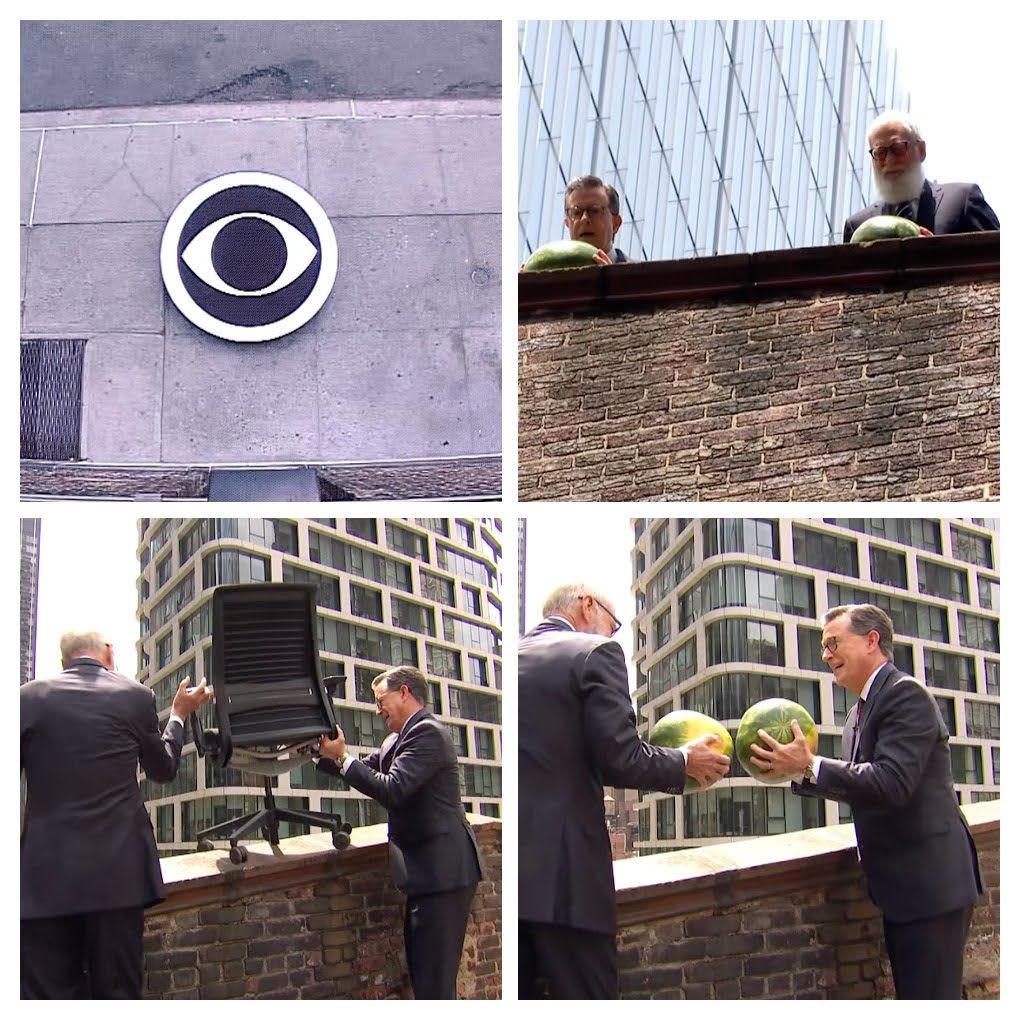
Letterman was back to blast CBS one more time last week as a guest on “The Late Show with Stephen Colbert,” which is not only the end for Colbert but for the franchise itself as it is being replaced next week by a stand-up comedy show fronted by Byron Allen. In Letterman’s final appearance, he and Colbert threw furniture and watermelons off the top of the Ed Sullivan Theater building, landing on the sidewalk below – right on top of the CBS eye logo.
Stephen Colbert has often been referred to as the thinking man’s late-night host, sort of a modern Dick Cavett. He often has one guest and allows them to speak freely and at length on a variety of subjects. His musical guests are very eclectic but always entertaining. His iteration of “The Late Show” has been the number-one rated late-night program for several years.
In a show of solidarity from his fellow late-night hosts, all of his competition is taking the night off and playing a rerun, encouraging their audiences to give Colbert their viewing attention for the evening.
Beyond this week, other than Byron Allen on CBS, the rest of the gang will still be around. Jimmy Fallon is still hosting the decidedly apolitical “Tonight” Show on NBC; despite threats from the President and investigation by the FCC, “Jimmy Kimmel Live!” is sticking around on ABC; and, NBC is staying behind a stripped-down “Late Night” with Seth Meyers.
Will the current crop of late-night hosts be the last to ever hold these jobs, or are we just engaged in a period of great change? For everyone who claims that late-night television is a dying genre, one need only look at the shows together drawing a greater audience between broadcast and online platforms than Johnny Carson ever did in his day.
Speaking of Carson, he often stayed away from tipping his hand to reveal his political leanings, choosing to poke fun at everyone instead. Going forward, that may be the best path for the late-night hosts who remain as they compete for viewers.
Late night is still where we go for big cultural moments, great interviews with newsmakers and celebrities, and performances by some of the greatest musicians working today. It is also a showcase for variety show-styled skits and sketches and one of the few places where stand-up comedians can be seen regularly.
In other words, just because CBS has decided to get out of the game for now doesn’t mean it is permanent. But May 22, 2026 will be remembered as the end of a couple of eras at CBS, and for that, we pause and reflect with gratitude for CBS Radio and for “The Late Show.”
Michael Bird is an assistant professor of music at Faulkner University.